AQA · GCSE · English Language
Non-exam assessment
The Non-Exam Assessment (NEA) for Spoken Language is a compulsory, separately endorsed component of your GCSE English Language. It assesses your ability to present information, use spoken Standard English, and respond to questions in a formal setting.
- 4 min read
- 3 worked examples
- 5 practice questions
- 8 key terms
Study Notes
Overview
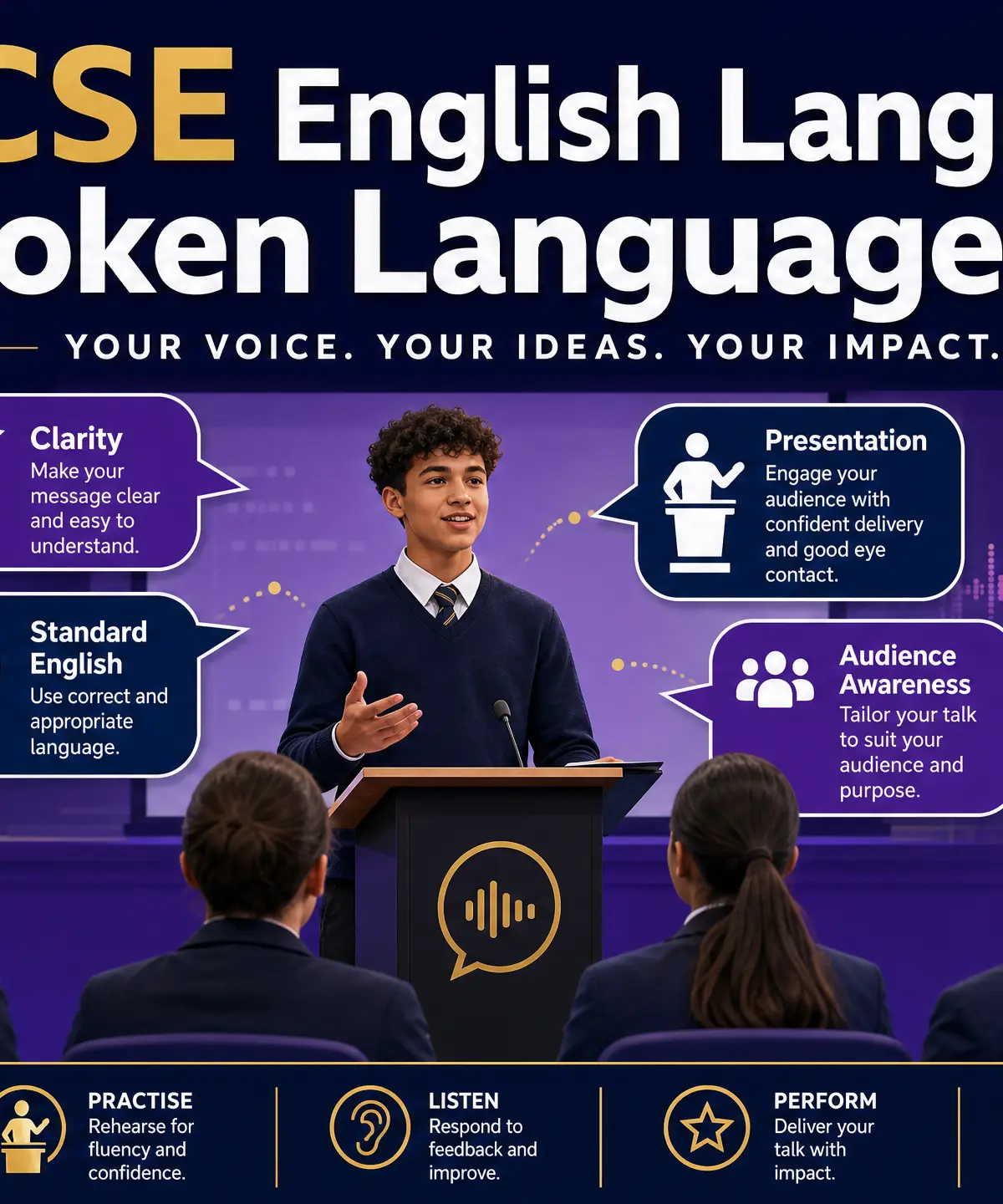
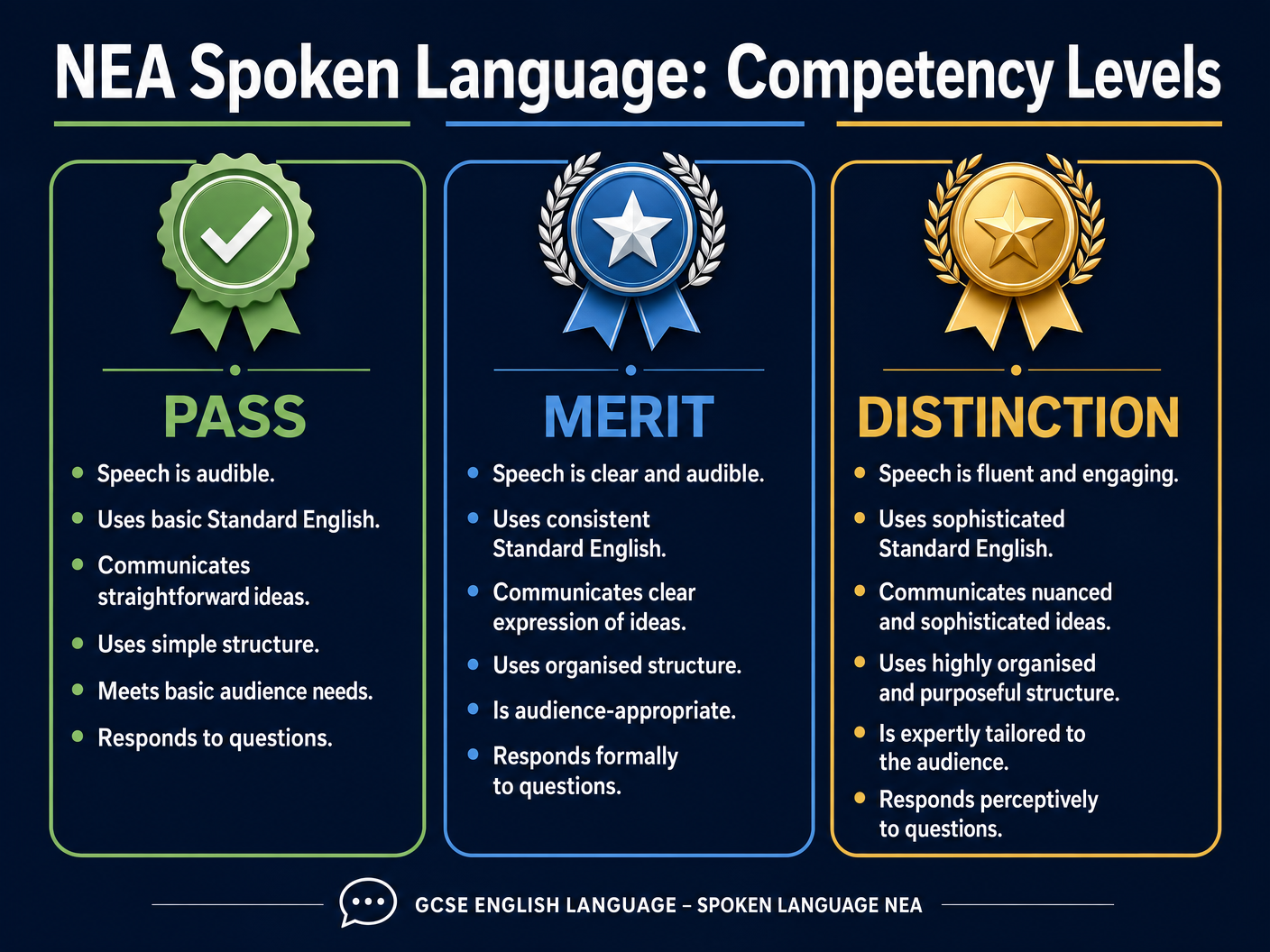
The Spoken Language Non-Exam Assessment (NEA) is a unique and exciting part of your GCSE English Language course. While it doesn't contribute points to your final 1-9 grade, it is a separately endorsed qualification that appears on your final certificate as a Pass, Merit, or Distinction. Universities, colleges, and employers look at this grade as proof of your ability to communicate effectively in a formal setting.
This component tests your ability to prepare a presentation on a topic of your choice, deliver it clearly to an audience, and respond thoughtfully to questions and feedback. It is a true test of your spoken communication skills, requiring you to move beyond casual conversation and demonstrate mastery of Standard English.
The Assessment Criteria
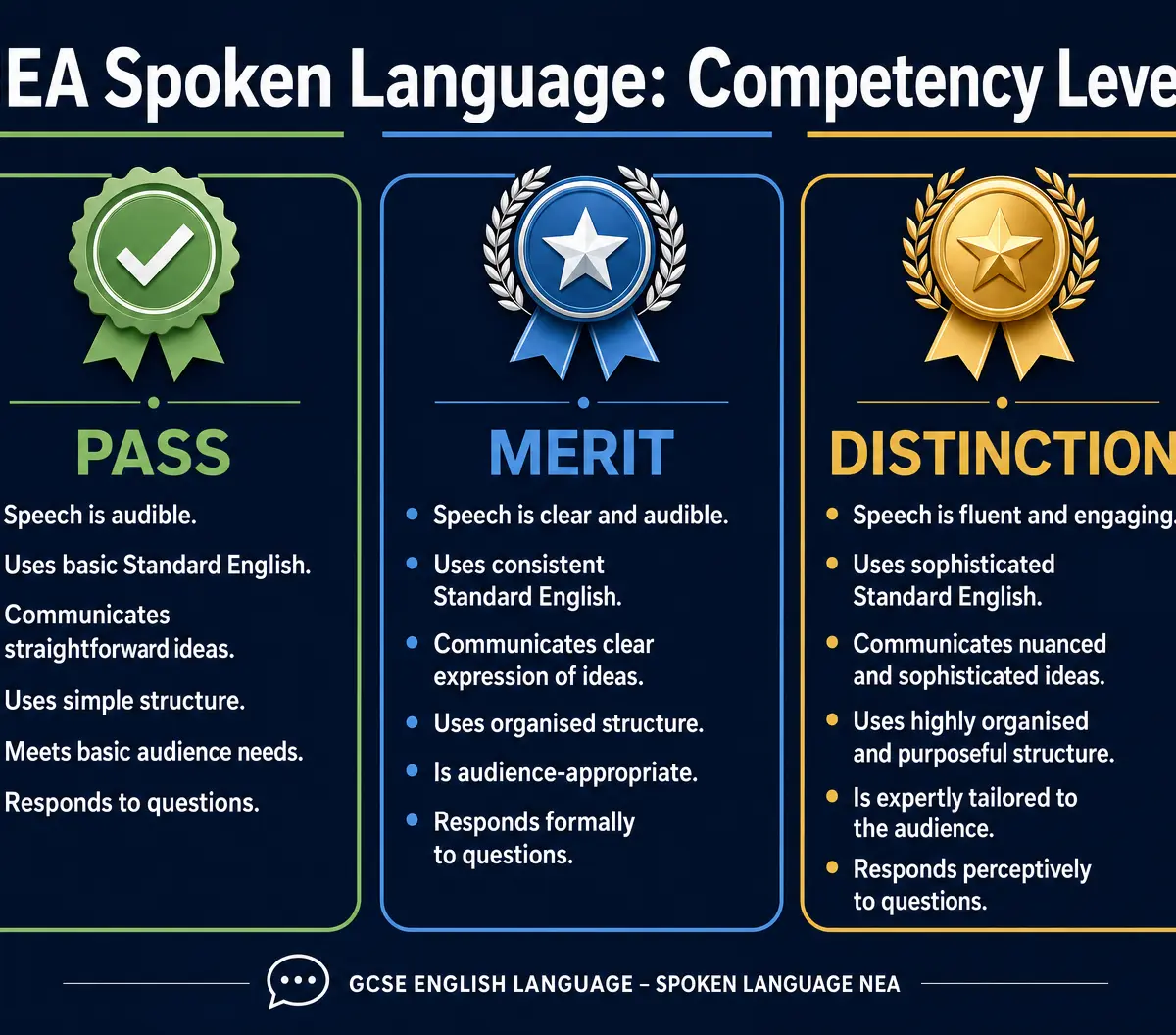
The assessment is holistic, meaning your teacher will look at your overall performance against specific competency criteria. You must meet all criteria in a band to be awarded that grade.
Core Skills
1. Expression of Ideas
Your presentation needs to have substance. At a basic level (Pass), you must communicate straightforward ideas. To achieve a Merit, your expression must be clear and structured. For a Distinction, you must communicate nuanced and sophisticated ideas. This means exploring the 'grey areas' of a topic, acknowledging different perspectives, and presenting a well-reasoned argument rather than just stating facts.
2. Organisation and Structure
A strong presentation isn't just a list of facts; it's a journey for the listener.
- Introduction: Hook the audience, state your purpose, and outline what you will cover.
- Main Body: Develop 3-4 key points logically. Use signposting language (e.g., 'Firstly', 'Building on this', 'Conversely').
- Conclusion: Summarise your main arguments and end with a powerful closing thought or call to action.
3. Use of Standard English
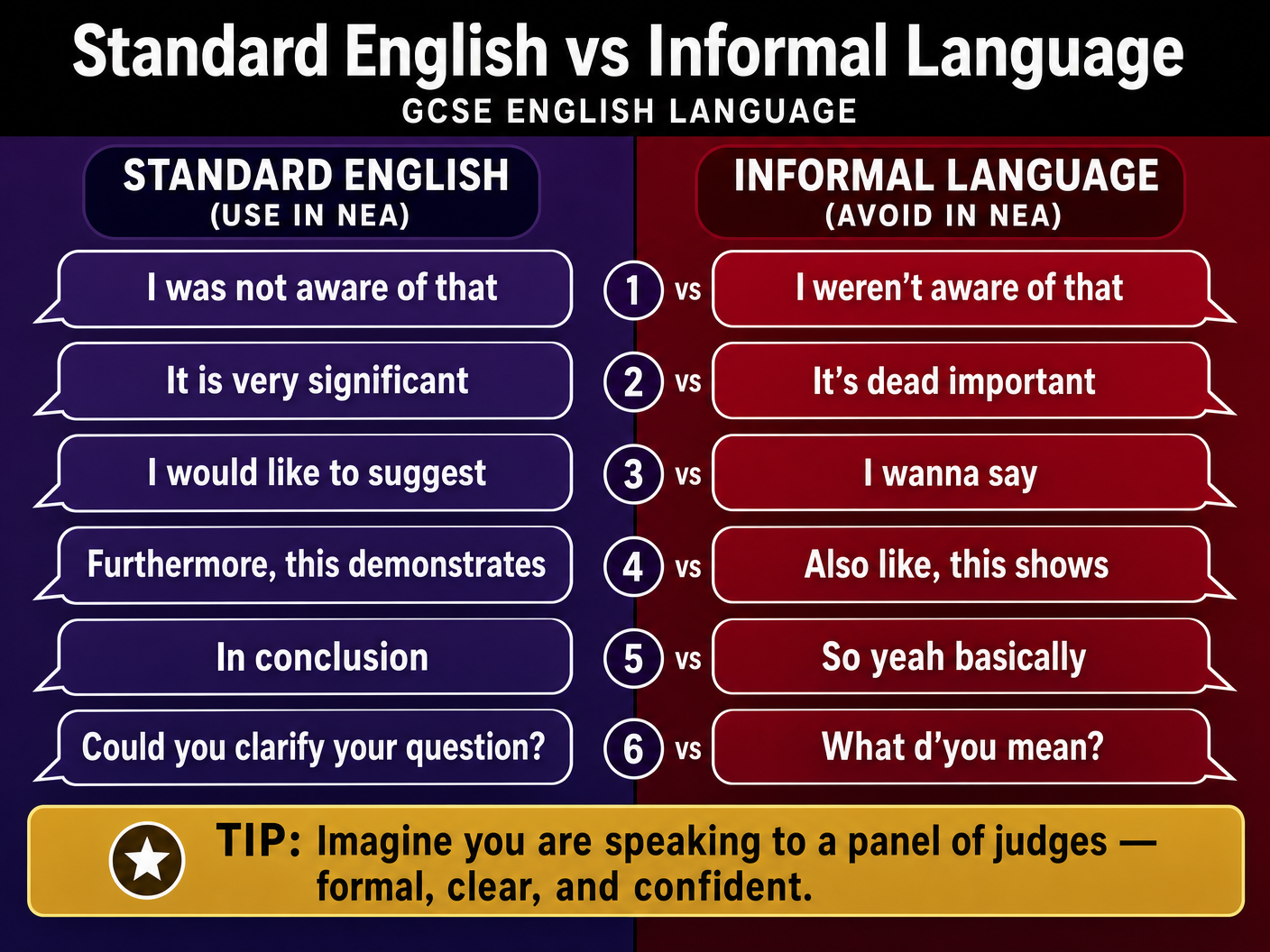
This is a formal assessment, and your language must reflect that. You must use Standard English, which means avoiding slang, colloquialisms, and non-standard grammar.
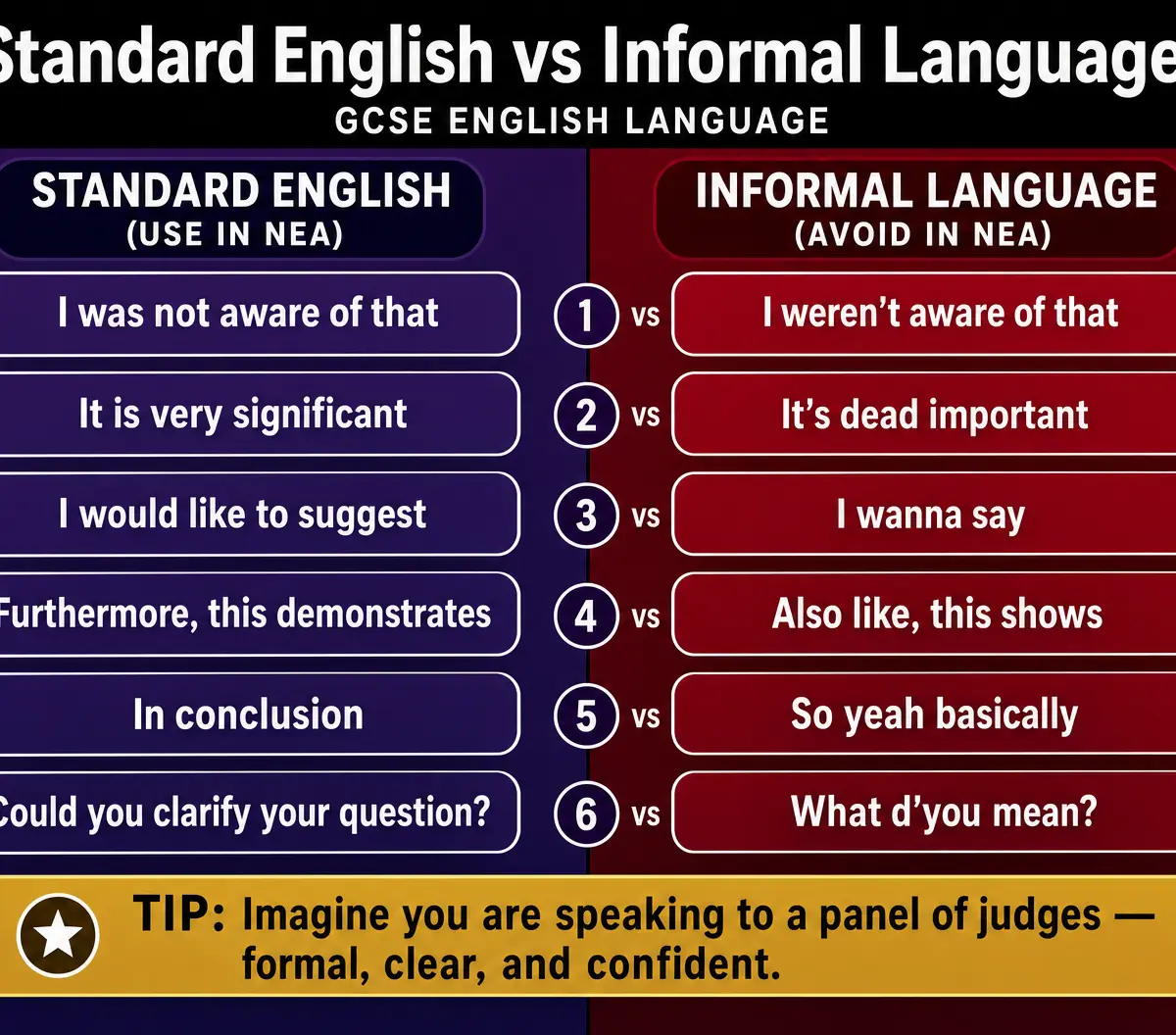
- Avoid: 'I'm gonna talk about...', 'It was well good', 'I were thinking...'
- Use: 'I am going to discuss...', 'It was highly effective', 'I was considering...'
4. Meeting the Needs of the Audience
Even if you are only presenting to your teacher, you must design your talk for a wider audience. This means you cannot assume they know everything about your topic. You must explain technical terms, provide context, and maintain a professional tone.
5. Responding to Questions
The presentation is only half the assessment. The Q&A session is equally important. You must listen carefully and respond appropriately. At Distinction level, this means responding perceptively — elaborating on your points, providing new examples, or even asking for clarification if a question is complex.
Listen to the Podcast
For a deep dive into the criteria and how to hit that Distinction, listen to our 10-minute revision podcast:
Visual Resources
3 diagrams and illustrations
Interactive Diagrams
2 interactive diagrams to visualise key concepts
Conceptual Flow Outline
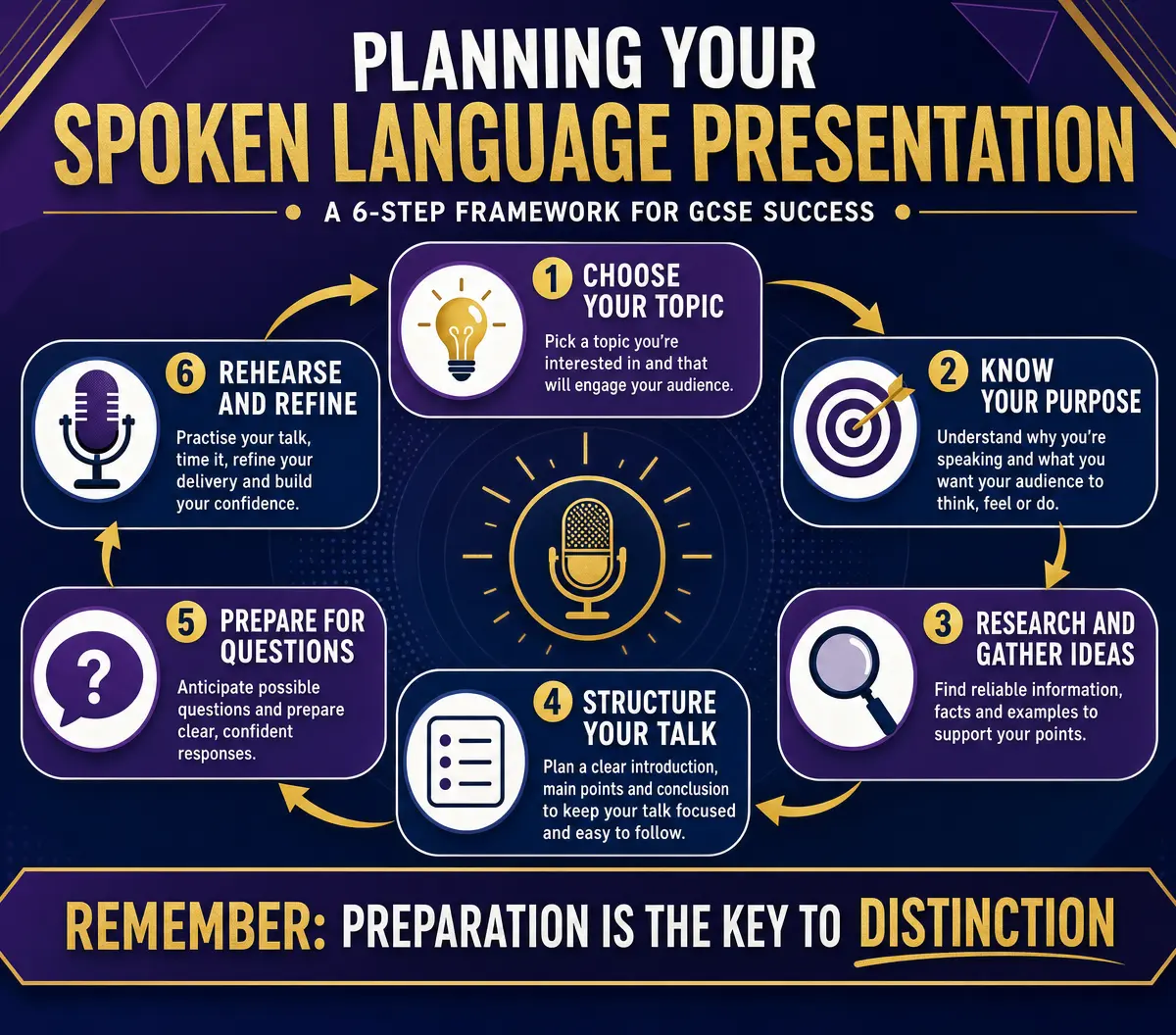
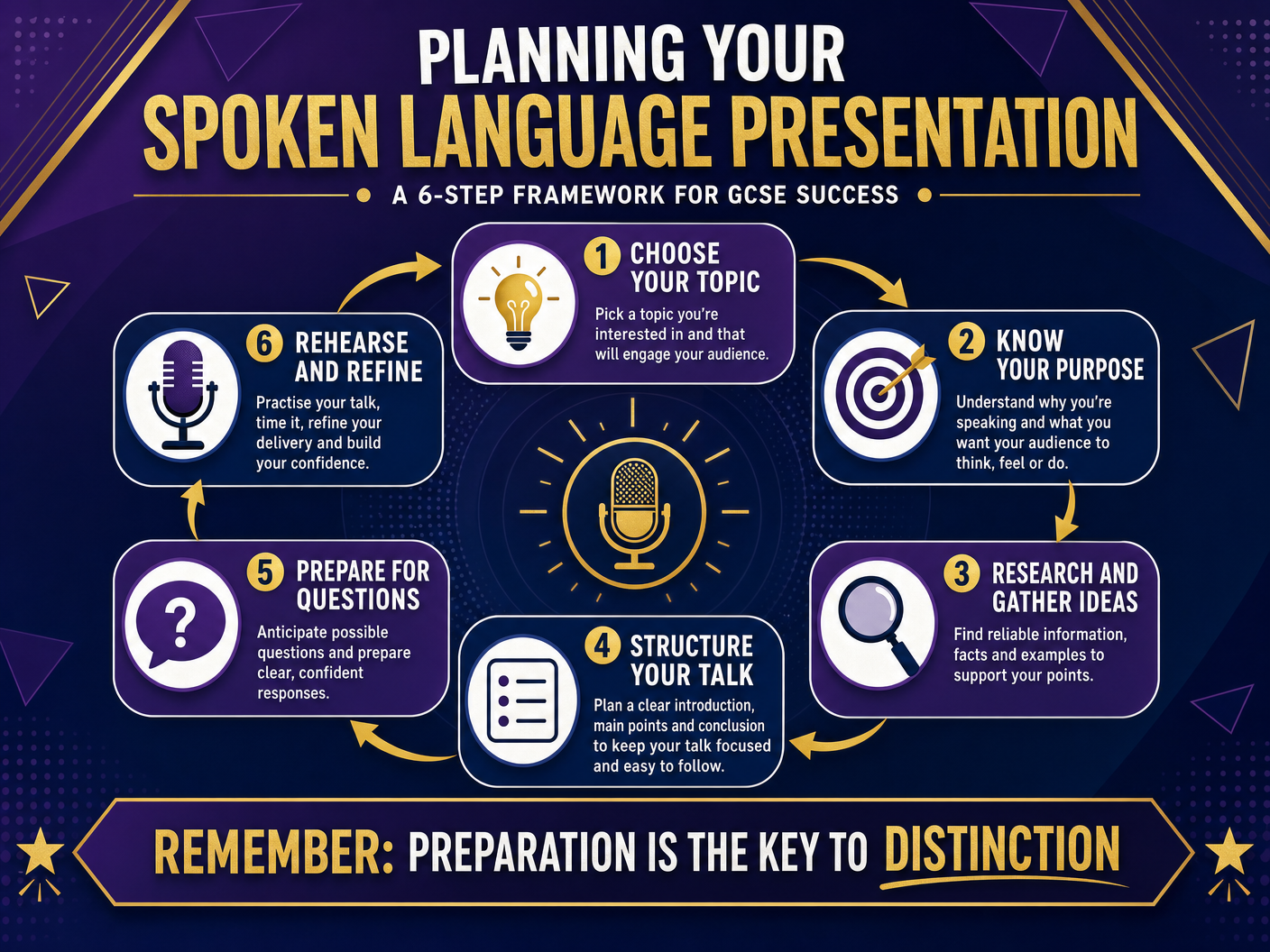
Preparation Workflow for Spoken Language NEA
Conceptual Flow Outline
Q&A Response Strategy
Worked Examples
3 worked examples — open one to explore the question and available guidance.
Practice Questions
Test your understanding — click to reveal model answers
Convert this informal sentence into Standard English: 'I'm gonna talk about why school uniforms are well annoying and we shouldn't have to wear them.'
Hint: Focus on removing slang ('gonna', 'well annoying') and elevating the vocabulary.
You are presenting on 'The Impact of Fast Fashion'. A student asks: 'But isn't fast fashion good because it lets poorer people buy clothes?' Draft a perceptive response.
Hint: Acknowledge the point, answer formally, and elaborate using the PEAR framework.
Explain how you would adapt a presentation about a highly technical hobby (e.g., building custom PCs) to meet the 'needs of the audience' criterion.
Hint: Think about jargon, context, and analogies.
Evaluate this introduction: 'Hi guys. Today my talk is on climate change. It's really bad. I'll tell you why.' Rewrite it to Distinction level.
Hint: Use a hook, formal language, and a clear signpost of structure.
During your Q&A, the teacher asks a question that you do not understand. How should you respond to maintain a Distinction-level performance?
Hint: Asking for help can be a sign of sophisticated communication if done correctly.
Test your understanding of Non-exam assessment
Active recall beats re-reading. Take an instant quiz now to test what you’ve learned and lock it into long-term memory.
7 days Premium · Then free forever · No card, no charge